Birders Dictionary (Part 1)
A quick guide to what the birders are saying

Hey folks, Wayne here again! As I delve into creating a space for myself on Substack I was thinking about what I should write about next. After being a birder for several years, I realized I take for granted just how much I know. With just an ornithology class as a background, I had to approach the world of birding with a Sibley guide book and a then unknown app known as “ebird".” It wasn’t until several years into birding where I met regular birders and started to learn many of the terms used in the birding community. ‘Lifer’, ‘nemesis’, ‘vagrant’, ‘warbler neck’, ‘First of Year’, etc. these were all terms I had not heard until I started birding with others. Therefore, I thought it would be fun to create a list with all the terms I have heard along the way. If you’re a birder who is just starting out, this may be the guide to help you feel hip with the lingo, or if you’re a seasoned birder maybe you’ll learn something along the way. I have a bunch of thoughts to go along with many of these terms, so this may turn into a multi-part series! Without any further ado, lets jump in!*
*Author’s note: Whenever I use a term for the first time I’ll make sure to bold and highlight it to help you keep track. On with the show!
The Basics
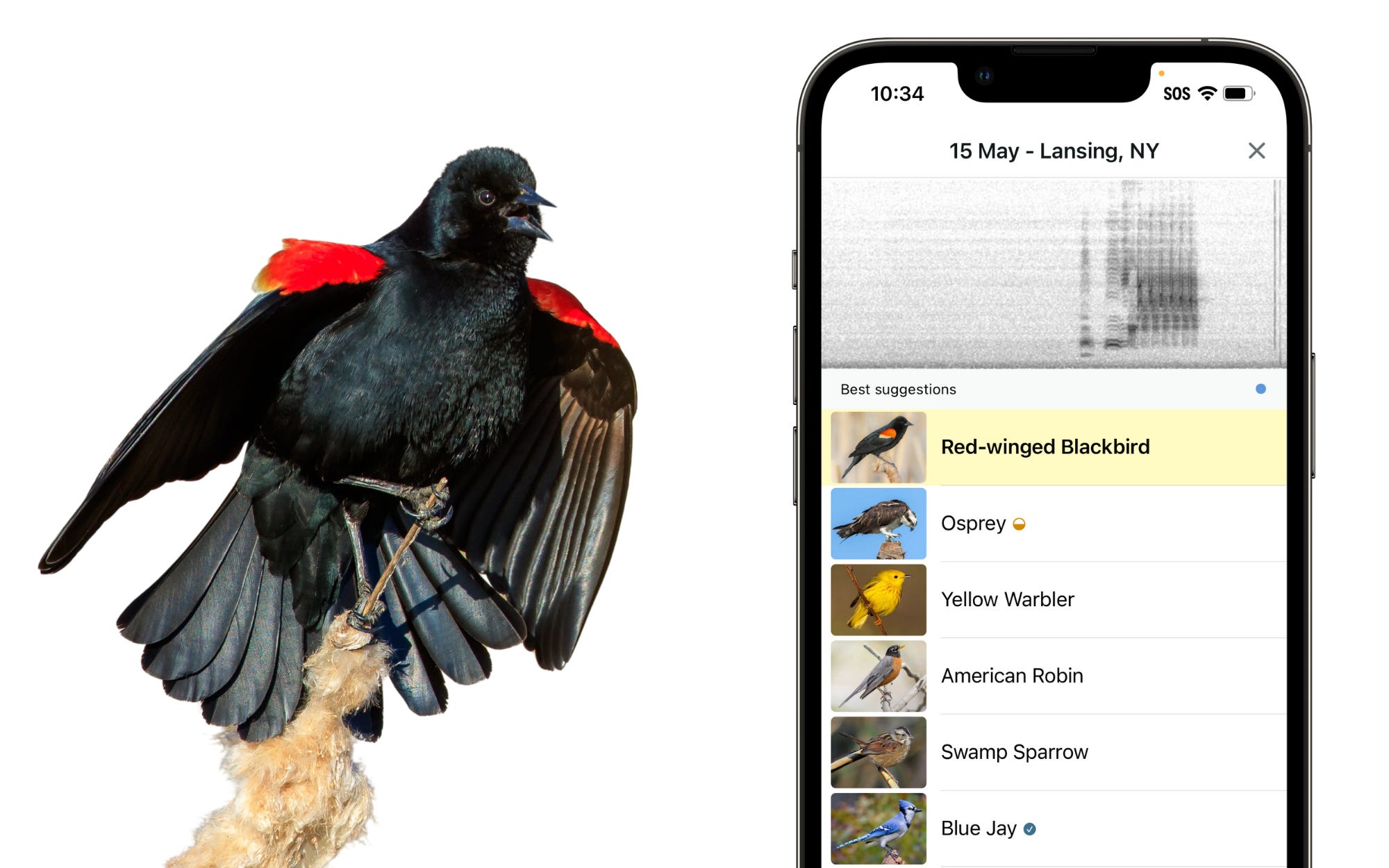
Let’s just pretend this is your first time going out birding with your local birding group (seasoned birders, you’re welcome to skip ahead), what are some terms you’d hear right off the bat? For starters, your guide is likely to mention they will be keeping a checklist on ebird for the walk. If this is the first time hearing about ebird you’re in luck! While ebird may seem like a way to simply document the birds you see on a stroll, it is much more than just that! This citizen science app allows you to mange your own personal lists, attach photos and audio recordings to your checklist, shows you real-time species distribution maps, and even alerts for where species are seen (more on that shortly). When taking a look at the explore tab, you can see a whole range of hotspots allowing you to take a closer look at what birds have been reported within that specific area. When entering in your sightings, you are presented with a list of likely birds in your area, with unusual sightings needing supporting evidence or else you’ll draw the attention of your local reviewer (a sore point for many). I’m just scratching the surface of what ebird provides, so learn more here (did I mention its all free??) A trusty companion app for ebird you’ll often see people using is Merlin Bird ID. You may hear someone saying to just ‘Merlin it’, now what does that mean? Well, Merlin ID is another (free) app that serves as your own field guide wherever you are. Like ebird, it provides you a list of birds in your area, but this time there are photos, range maps, sounds, descriptions of the birds, and the likelihood of seeing that bird today. Not only that, but if you click ‘Sound ID’ it will starting listening to sounds around you and tell you what it hears. If you manage a grainy photo of a bird on your phone, you can even ask it what bird it is. We truly are in a wonderful age of birding, it has never been easier to get into birding! A quick note before we keep going, Merlin is a wonderful tool to help you learn your local (or foreign) birds while you are out, however one should not fully rely on it while out in the field. Why do you ask? Well as someone who literally listened to thousands of bird calls from my thesis (no joke), I can confidently say that sound ID software does not always get it right, I’d say its about 85% accurate. In fact, many birders make silly games of trying to do their best bird impression to see if they can fool Merlin! Many birds are capable of amazing mimicry (which confidently fools Merlin), I’m looking at you Blue Jays, Northern Mockingbirds, and European Starlings. Also, its important for you to download the correct packs for your area, otherwise you’ll be getting species for other countries potentially! I’d say a safe rule is to spot the bird first (especially if its new for you), and then add it to your checklist!
Alert, Alert!
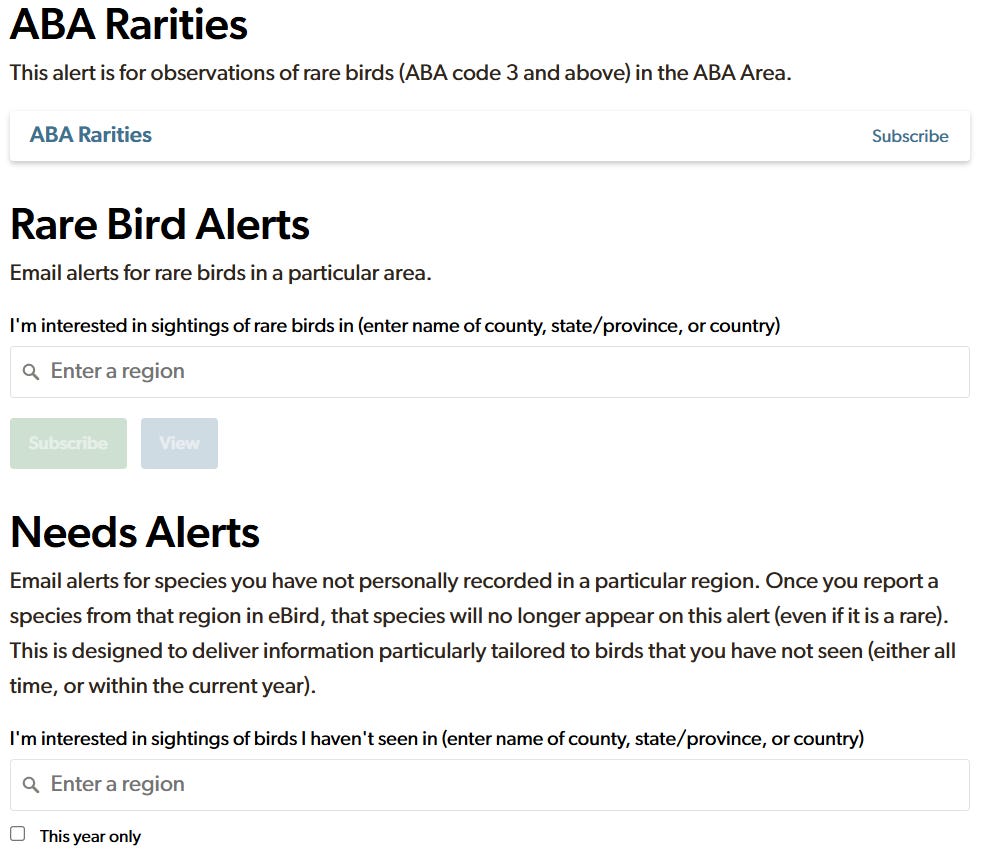
In the days of old, long before the world wide web, how did birders manage to hear about local rarities in their area? Well, they would call a birding by phone service to learn about rare birds across the country or within the state. Calling this number would allow the birder to hear a list of that week’s unusual sightings! These Rare Bird Alerts are what many birders live for as they look for birds that are uncommonly seen within their local community, state, or even the country! Today, the process has become much more streamlined and customizable for birders. Interested in sightings for just your country? Maybe that’s too broad and you just want updates across your state? Perhaps you want updates for the county you live in? Or maybe you want alerts about a certain species you’ve been looking for? eBird alerts are your best friend here and allow you to bird to your preferences, sending you a daily e-mail with whichever alerts you signed up for. Those who only bird at a single local hotspot may be known as a local patch worker, while those who bird around their county are aptly named county birders. Many folks determine what constitutes as rare by taking a look at the different codes that the American Birding Association (ABA) provides. The ABA is nonprofit group focused on recreational birding that found its purpose in listing and identifying rare birds.
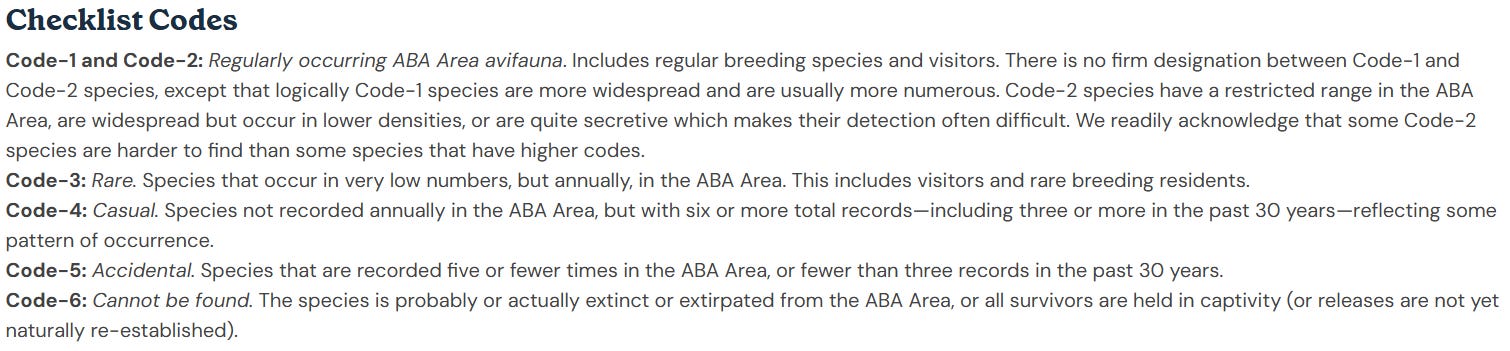
As you take a look at the Rare Bird Alert, certain terms my start to pop up over and over. One that commonly shows up is a vagrant bird. This is a bird that really got lost. This species will be found significantly outside of its normal breeding range, its wintering area, or even where it typically migrates. One recent example that comes to mind are American Flamingos, who in the aftermath of Hurricane Idalia in 2023 turned up in 17 different unusual states ranging from Wisconsin to Pennsylvania. Another is first of the year (FOY) which is simply the first time a birder has spotted that particular species within that calendar year. This one typically comes from a place of joy, as it means that birds who were wintering down south or up north have returned from their long treks to stick around for their breeding season. I too experience this elation when the warblers return from their wintering grounds and begun to fill our local birding spots with their wonderful songs! With their capacity to stick to the treetops, you may develop a painful case of warbler neck if you spend too long looking for these beautiful songsters! There’s a whole plethora of terms used for these alerts and this may require further investigation in a future article!
Are you enjoying this article, but don’t quite have the funds for a subscription? That’s alright! Every little bit helps:
Gather Round!
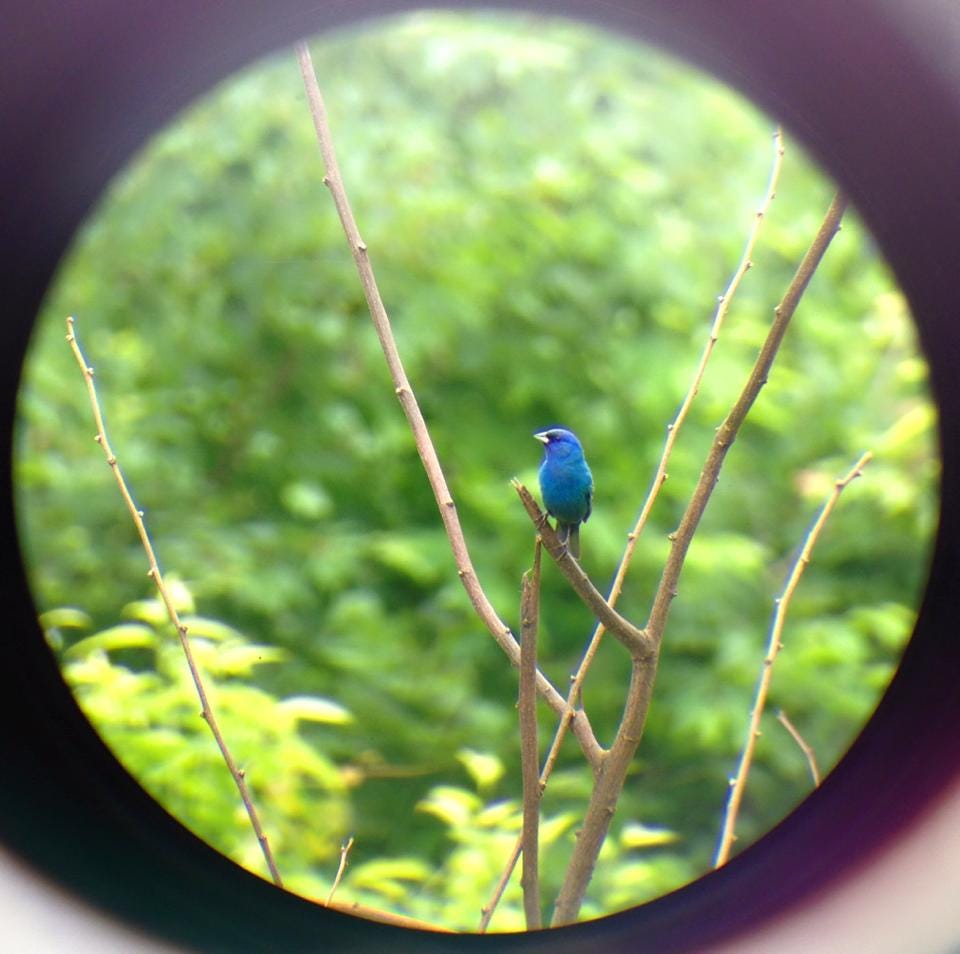
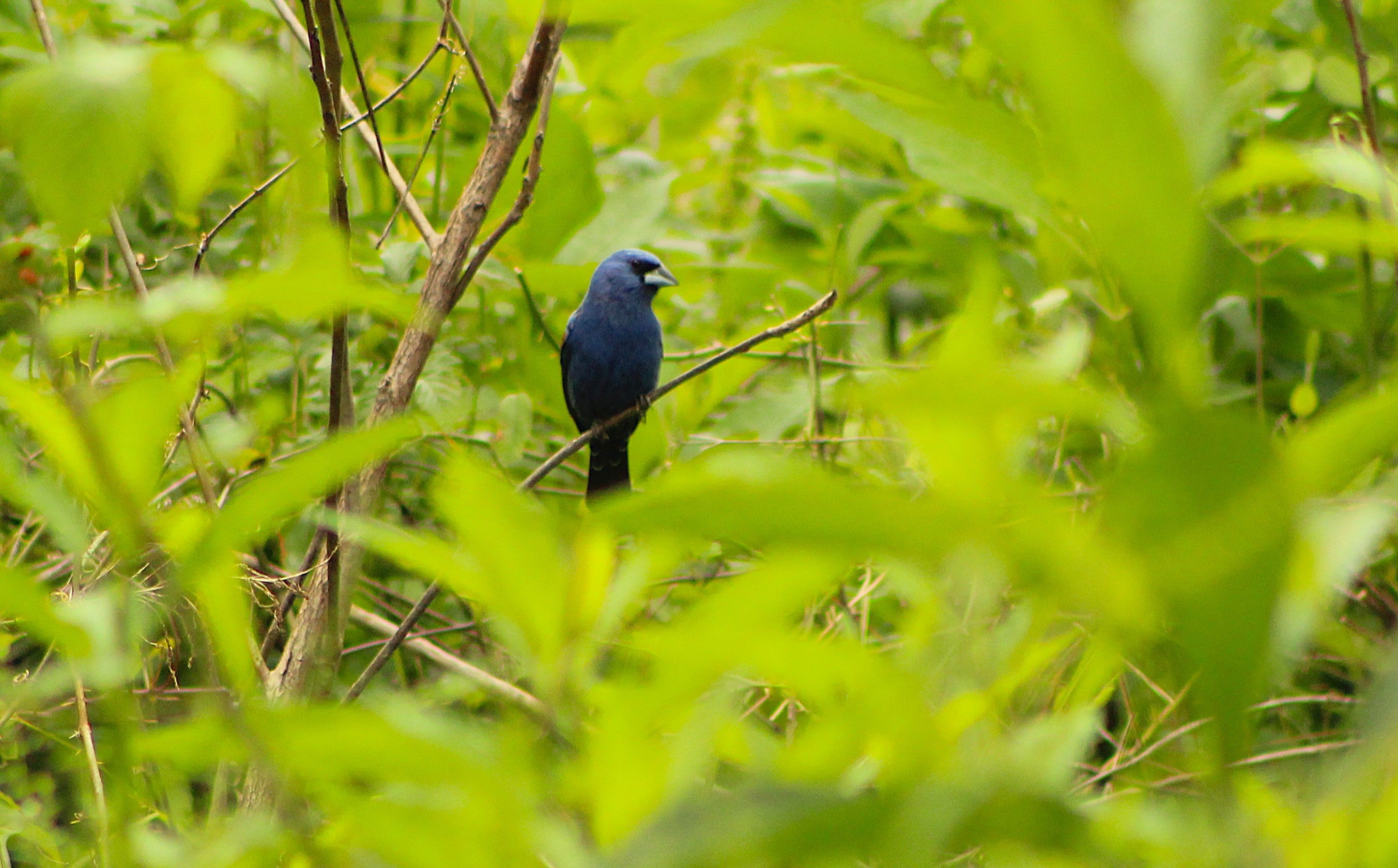
After a successful day of birding you may to decide to join birders for dinner or at a local pub to recount birding adventures. Here’s where you’ll hear a lot of birder lingo you may already be familiar with. One of the most common terms is of course a lifer! This is the term used when you see a new bird for the very first time on your birding journey! Seeing a new bird in the wild is one of the best joys birding can provide. The more you bird the harder seeing a lifer becomes, which is why you’ll always find birders traveling to new destinations across the world. One popular question when getting to know new birders is often “what is your spark bird?” A spark bird is the bird that ignited your love for birding. This question is always great because the answer varies with whoever you ask. For me, it was an Indigo Bunting I saw through a spotting scope along the Blue Ridge Parkway during my ornithology class in college. There was something that took my breath away about how vibrant and adorable that bird was and I just needed to learn more! On the opposite end of the spark bird is your nemesis bird. This is a pesky bird that always seems to get away from you, or maybe one you’ve tried to see multiple times without any success. The Connecticut Warbler is one such bird for me. This bird is a skulker (a bird that is reclusive, hard to spot, and typically hides out in dense undergrowth) and has eluded me for a few years now, despite my best efforts to see it!
To be continued…
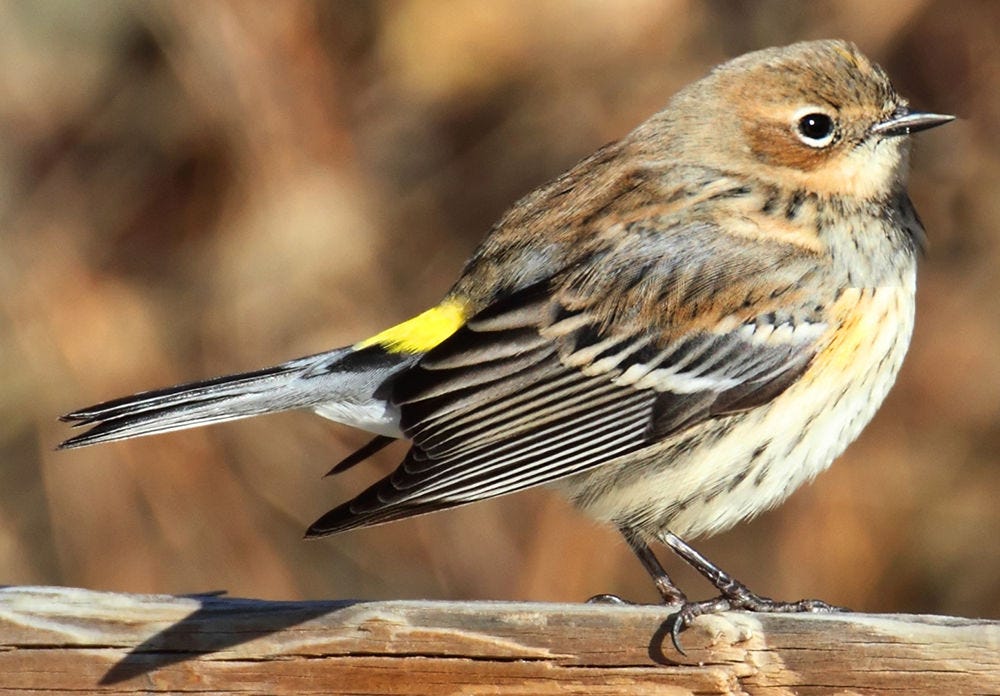
We really are just scratching the surface for all the fun terms birders use to talk about their favorite critters! In fact as I began to write this I kept finding more terms that I really wanted to dive into. You may be asking yourself what about ‘listers’, ‘endemics’, ‘pishing’, ‘fallout’, ‘lumpers’ and other terms you want to know more about? What about all the fun little nicknames we use for birds like ‘shorbs’, ‘LBBs’, ‘peeps’, and more we use while out birding? What the heck is going on with the American Ornithological Society and why do they classify birds with four-digits letters like ‘RSHA’ and ‘CARW’ for research? All I can say is that you’ll just have to join me in Part Two of the Birders Dictionary coming to a Substack near you! For now I’ll leave you with one last fun tidbit. The Yellow-rumped Warbler is an adorable warbler seen across North America with a range of black and white plumage, yellow patches, and… a bright yellow spot right above its tail feathers. Can you see where I’m going with this? I’ll leave all with a photo of warblers affectionately nicknamed ‘butterbutts’ Happy Birding!
Thank you for this Wayne. I've had a lifelong passion for wildlife - but only discovered 'birding' as such since I started writing on Substack! I guess I've always been a kind of 'casual' birder - but I love learning more about it.
I just discovered eBird this weekend - when I had to find out what a bunch of people were doing standing around by the roadside with long lens cameras. Apparently they were photographing waxwings! I realised I need something to alert me to these kinds of things...